If you live in a hard water area, you already know the signs: a white crust on the taps, cloudy shower screens, a kettle that furs up within weeks and an immersion that never seems to last. A water softener is the only thing that stops that limescale at every tap in the house. Here are the real benefits of a water softener for an Irish home, what it won't do, and how to tell whether your house needs one.
Quick answer
- No more limescale on taps, shower screens, tiles, kettles and inside the cylinder, the immersion and the boiler.
- Longer life for appliances that heat water, such as electric showers, washing machines, dishwashers and combi boilers.
- Less soap and detergent, because soft water lathers easily.
- Much less cleaning, with no white marks coming back.
- Worth it? If your water is hard, 200 mg/L or more, yes for most homes. Check yours with our Eircode hardness checker.
How a water softener works
Hard water carries dissolved calcium and magnesium, the minerals that turn into limescale, especially when water is heated. A water softener is a tank of resin beads fitted on the incoming cold mains. As the water passes through, the beads grab the calcium and magnesium and swap in a small amount of sodium instead. The water that comes out is soft and won't form scale.
When the resin is full, the softener regenerates. It rinses the beads with salty water from its salt tank, knocks the hardness off and sends it to drain. A modern metered softener, like the AquaSilk range, only does this when the resin is actually used up, so it isn't wasting salt or water on a fixed timer. The salt itself never goes into your pipes. It's only used to recharge the resin.
The benefits of a water softener at a glance
| Where in the house | On hard water | With a softener |
|---|---|---|
| Bathroom | Chalky marks on glass, tiles and chrome. Shower heads clog | Surfaces wipe clean and stay clear. Shower heads keep their spray |
| Kitchen | Furred kettles, scaled taps and aerators, spots on glasses | No new scale in the kettle, cleaner taps, clearer glasses |
| Hot water | Scale builds on the immersion element, the cylinder coil and the boiler heat exchanger | Heating surfaces stay clean, so heat gets into the water as it should |
| Appliances | Electric showers, washing machines and dishwashers scale up and fail sooner | No scale forming on their heaters and valves |
| Washing and laundry | Poor lather, soap scum, more detergent needed | Easy lather and clean rinsing with less product |
Protects your cylinder, immersion and boiler
This is the benefit that matters most in a hard water area. When hard water is heated, the calcium comes out as solid scale and coats whatever is doing the heating. Limescale on an immersion element or in a boiler heat exchanger acts as an insulating layer, so more energy goes into heating the scale and less into heating your water. Over time, that's what burns out elements and chokes heat exchangers.
A combi boiler is especially exposed. It heats water on demand through a small plate heat exchanger, which is one of the first parts to scale up on hard water. Electric showers, kettle elements and washing machine heaters go the same way. A softener stops the scale forming in the first place, so these parts keep working the way they were designed to.
Less cleaning, and it stays clean
On hard water, every drop that dries leaves a little ring of chalk behind. That's the film on shower screens, the crust around tap bases and the white marks on the draining board. With softened water the marks simply don't come back. Bathrooms and kitchens take a quick wipe instead of a scrub, and you can stop buying limescale removers.
Uses less soap, shampoo and detergent
Calcium and magnesium react with soap and stop it lathering, which is where soap scum comes from. Soft water lathers easily, so you need less washing-up liquid, shampoo, shower gel and laundry detergent to get the same result, and it rinses off cleanly. The dishwasher and washing machine work better too, and clothes and towels don't come out stiff with mineral residue.
Already have hard limescale? A softener stops new scale forming. Marks on taps and screens wipe off and don't return, but a heavily scaled kettle or immersion element won't clear on its own. Descale or replace it once, and the softener keeps it clean from then on.
What a softener won't do
It's worth being straight about the limits, so you buy the right thing:
- It doesn't filter the water. A softener only removes hardness. It doesn't take out chlorine taste, fluoride, bacteria or other contaminants. For drinking water, that's a job for a reverse osmosis system.
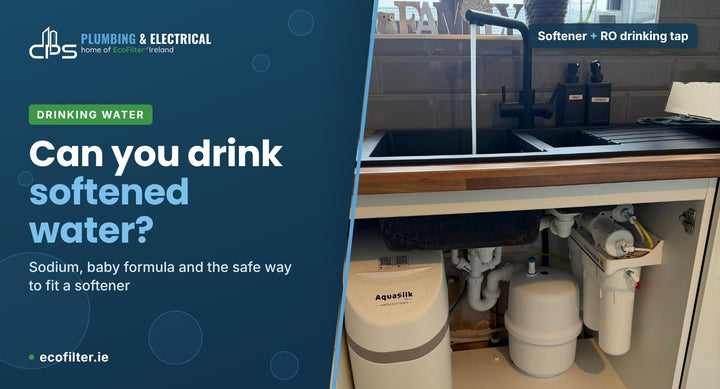
- Keep a hard tap for drinking. Softened water is safe for most adults to drink, but it carries a little extra sodium. The HSE advises against using water from a softener to make up baby formula, because it may contain too much sodium. We keep the kitchen cold tap on unsoftened water on every install. Read more in Can You Drink Softened Water?
- No health claims. Soap rinses off more easily in soft water, and many people like the feel of it, but we don't claim a softener treats dry skin, eczema or any other condition. If you have a skin condition, talk to your GP or pharmacist.
- Well water may need treating first. Iron, manganese or sediment in a private well will foul the resin, so it needs pre-treatment ahead of the softener. See our well water treatment page.
Do you need a water softener?
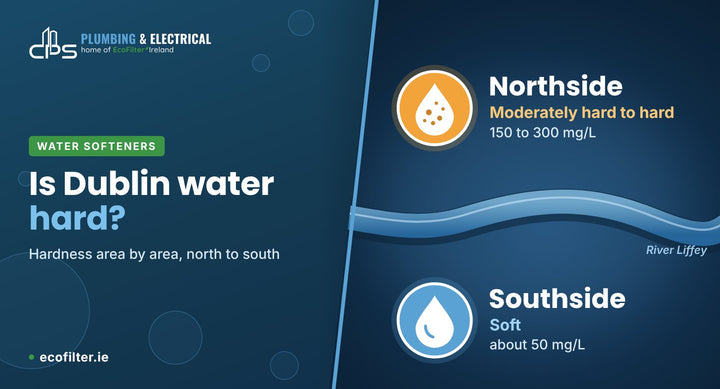
It depends on how hard your water is. This is the scale we use, measured in mg/L as calcium carbonate:
| Hardness | Rating | Is a softener worth it? |
|---|---|---|
| Under 100 mg/L | Soft | No, you don't need one |
| 100 to 199 mg/L | Moderately hard | Comes down to how much the limescale bothers you |
| 200 to 299 mg/L | Hard | Yes, for most homes |
| 300 mg/L and over | Very hard | Yes, you'll see the difference quickly |
Find your figure in a few seconds with our Eircode hardness checker, or see the hardness levels by county. If you're on a private well, the lab report will show it.
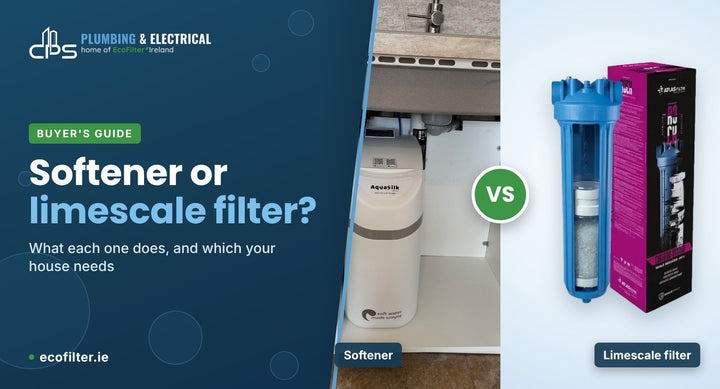
Salt-free limescale filters and conditioners cost less, but they don't remove hardness, and shower head filters don't soften water at all. We explain the difference in Water Softener vs Limescale Filter.
What it costs, and which size to choose
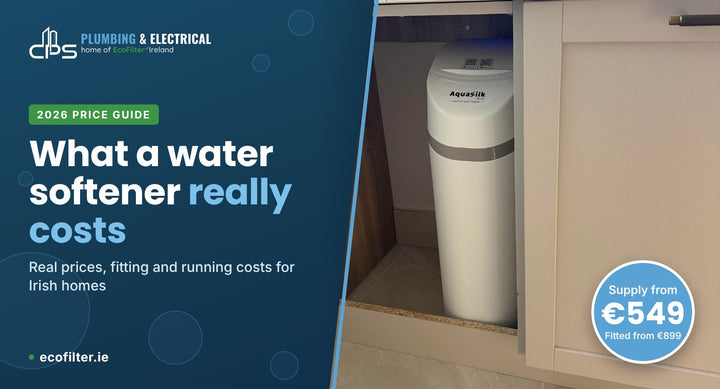
Our AquaSilk softeners are compact cabinet units that fit under the kitchen sink, in a utility room or in a press, with a socket and a drain close by. Prices on our website today:
| Softener | Best for | Supply only | Supplied and fitted |
|---|---|---|---|
| AquaSilk Mini 8L | 1 to 5 people, one bathroom, tight spaces | €549 | €899 |
| AquaSilk Midi 14L | Most family homes | €689 | €999 |
| AquaSilk Maxi 21L | Large homes, several bathrooms, very hard water | €779 | €1,150 |
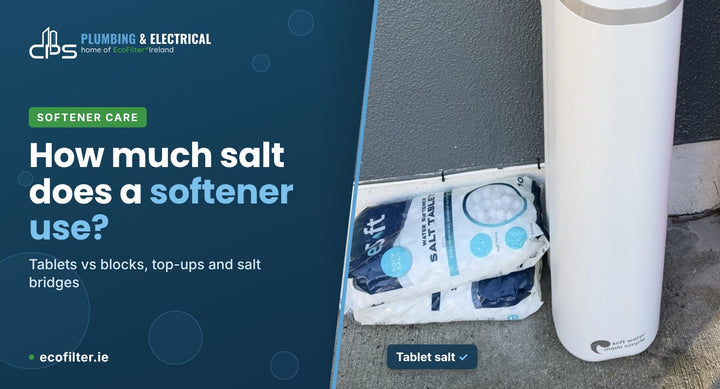
Running costs are low. Salt is the main one: a family of four on hard water uses roughly 6 to 11 kg a month on a modern metered softener, and the AquaSilk runs off a small 12-volt adapter. Our water softener cost guide covers installation, running costs and what can push the price up, and the Mini vs Midi vs Maxi guide helps you pick a size. See the full range on our water softeners page.
Ready to stop limescale for good?
Tell us your Eircode and how many live in the house, and we'll recommend the right softener and give you a fitted price. Our own team fits nationwide except Donegal, Kerry, Leitrim and Sligo.
 5-star rated on Google
Common questions
Is softened water safe to drink?
Yes, for most healthy adults. It carries a little extra sodium, so we keep the kitchen cold tap on unsoftened water for drinking, cooking and baby feeds.
Does a water softener need a lot of looking after?
Very little. Check the salt once a month and top it up, and clean out the salt tank every year or two. Our salt guide covers the rest.
Will a softener reduce my water pressure?
Not noticeably, if it's sized for the house. Bigger homes with more bathrooms need the larger models so the flow keeps up.
Do I need a softener with a combi boiler?
In a hard water area it's well worth it. The plate heat exchanger in a combi is one of the first parts to scale up, and a softener stops that scale forming.
Will a shower head filter do the same job?
No. Shower head filters don't soften water and won't stop limescale. Only a softener removes the hardness itself.
Still seeing limescale after fitting a softener?
Usually the salt has run out, a crust has formed in the salt tank or the hardness setting is wrong. Work through our troubleshooting checklist.