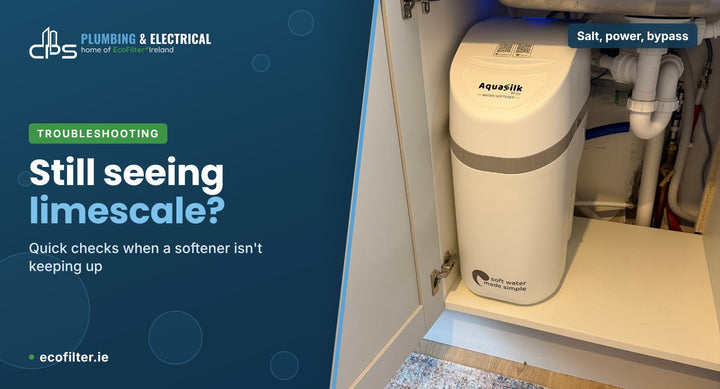
It's the question we get asked on nearly every softener job: is it safe to drink the water once the softener is in? The short answer is yes for most adults, but there are a couple of exceptions worth knowing about, and there's a simple way of fitting a softener that takes the question off the table altogether.
Quick answer
Softened water is safe for most healthy adults to drink. Softening swaps the calcium and magnesium in hard water for a small amount of sodium, and in most Irish supplies the result stays well under the 200 mg/L sodium limit for drinking water. But it shouldn't be used to make up baby formula, anyone on a low-sodium diet should check with their GP, and in very hard areas the sodium figure gets closer to the limit. That's why we always keep one unsoftened cold tap in the kitchen for drinking and cooking.
Why softened water has more sodium in it
A water softener works by ion exchange. Inside the unit is a tank of resin beads. As hard water passes through, the beads grab the calcium and magnesium (the minerals that make limescale) and release sodium in their place. When the resin is full, the softener regenerates: it rinses the beads with salty water from the brine tank, which knocks the calcium and magnesium off, and sends the lot to drain.
So the salt itself never goes into your pipes. What changes is that some sodium is swapped in for the hardness that's taken out. Softened water doesn't taste salty. Most people say it tastes slightly smoother, and tea made with it doesn't get that scummy film on top.
How much sodium does a softener add?
It depends entirely on how hard your water was to begin with. For every 1 mg/L of hardness removed (measured as calcium carbonate), a softener adds about 0.46 mg/L of sodium. That's simple chemistry: two sodium ions replace each calcium or magnesium ion.
| Hardness before softening | Example | Sodium added |
|---|---|---|
| 75 mg/L | South Dublin (Vartry and Ballymore Eustace) | about 35 mg/L |
| 200 mg/L | North and west Dublin (Leixlip supply) | about 92 mg/L |
| 300 mg/L | Typical of Carlow, Kilkenny and the midlands | about 138 mg/L |
| 336 mg/L | North Fingal (Bog of the Ring supply) | about 155 mg/L |
| 400 mg/L | Some private wells | about 184 mg/L |
Add whatever sodium is already in your water before softening. Your supplier's water quality report or a lab analysis will show it.
The limit for sodium in drinking water under the EU Drinking Water Directive and Ireland's 2023 Drinking Water Regulations is 200 mg/L. On typical Irish hard water, softened water comes in comfortably under that. On very hard water, or a well that already carries some sodium, it can get close, which is one more reason to keep a hard tap for drinking. You can look up your own hardness with our Eircode hardness checker.
To put the numbers in context, a litre of softened water from a 300 mg/L supply carries roughly 140 mg of sodium. The World Health Organization recommends adults keep total sodium intake under 2 grams (2,000 mg) a day, and most of that comes from food.
Babies and formula: use the unsoftened tap
This is the one rule there's no grey area on. The NHS advice on making up infant formula is clear: do not use artificially softened water, and do not use water that's been boiled before. Formula is designed around a precise mineral and sodium balance, and young babies' kidneys can't deal with extra sodium the way an adult's can.
Making up bottles? Use fresh cold water from the unsoftened kitchen tap, boiled once, exactly as your formula's instructions say. Never use the softened supply.
Low-sodium diets and medical conditions
If you've been told to watch your sodium intake, for example for blood pressure, heart or kidney reasons, speak to your GP before drinking softened water regularly. In practice the easiest answer is to drink from the unsoftened tap, or from a reverse osmosis drinking water tap (more on that below).
The way we fit softeners: a hard tap for drinking
Standard good practice, and what we recommend on every install, is to keep one cold tap in the kitchen on unsoftened mains water. Everything else in the house, the hot water, showers, baths, toilets and appliances, gets softened water and stays free of scale. You drink and cook from the hard tap.
Two common ways to do it:
- Keep the kitchen cold tap on the mains. The softener is fitted after the kitchen cold branch, so that tap stays unsoftened. Simple and cheap.
- Add a dedicated drinking water tap. A separate tap, or a 3-way kitchen tap, gives you a hard or filtered supply alongside softened hot and cold.
Want the best of both? Add reverse osmosis
A reverse osmosis (RO) system under the sink removes the great majority of dissolved salts from the water, including the sodium a softener adds, along with chlorine taste, limescale minerals and much more. Fed from a softened supply, an RO membrane also tends to last longer because it isn't fighting hardness.
That's exactly what our softener plus RO package (€1,199 fitted) gives you: soft water everywhere, and filtered drinking water from its own tap at the sink. If you already have a softener, an RO system can be added separately. See our drinking water systems from €399 fitted.
Cooking, the kettle and the garden
- Cooking: fine for most people, but if you're using the hard tap for drinking, it's easiest to use it for cooking too.
- The kettle: softened water won't scale your kettle, but use the drinking tap if you're making up formula or watching your sodium.
- Plants and the garden: use unsoftened water. Sodium isn't good for plants or soil, which is another reason to keep the outside tap off the softener.
Soft water everywhere, clean water to drink
We'll fit your softener with the kitchen cold tap kept hard for drinking, or add reverse osmosis for filtered drinking water. Fitted nationwide except Donegal, Kerry, Leitrim and Sligo.
 5-star rated on Google
Frequently asked questions
Does softened water taste salty?
No. The salt never enters your supply. It's only used to recharge the resin and is rinsed to drain. Softening adds a small amount of sodium, which most people can't taste, and many find softened water tastes smoother.
Can I make tea and coffee with softened water?
Yes. Tea made with softened water won't get the scummy film you see with hard water, and your kettle won't scale up. If you're watching your sodium intake, use the unsoftened tap instead.
Can I use softened water for baby formula?
No. The NHS advises against using artificially softened water to make up infant formula. Use fresh water from the unsoftened kitchen tap, boiled once, as the formula instructions say.
Does a water softener remove chlorine or fluoride?
No. A softener only removes hardness, meaning calcium and magnesium. To remove chlorine taste, fluoride and other dissolved substances from drinking water, you need a reverse osmosis system.
Is softened water OK for watering plants?
It's best not to use it. The added sodium isn't good for plants or soil, which is why we recommend keeping the outside tap on hard water.