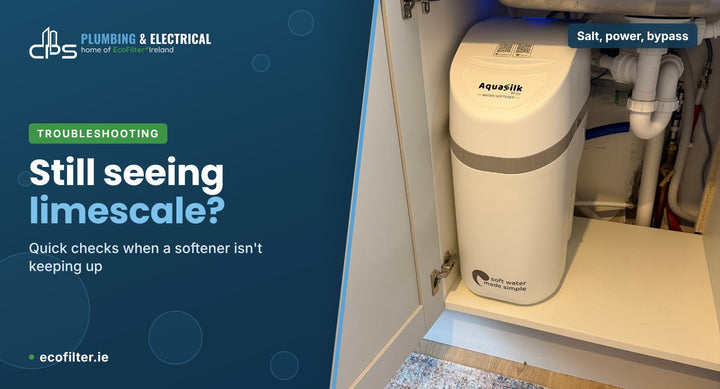
Search for a fix for limescale and you'll find two very different kinds of product sold side by side: salt-based water softeners, and salt-free limescale filters or conditioners. They're not the same thing, they don't do the same job, and the right one depends on your water, your house and what's actually bothering you. We sell and fit both, so here's a straight comparison.
Quick answer
A water softener removes the calcium and magnesium that cause limescale, so scale stops forming anywhere in the house. It's the only complete fix. A limescale filter or conditioner leaves the hardness in the water but changes how it behaves, so less scale sticks, mainly where water is heated. It needs no salt, no drain and little space, but your water still tests hard and you'll still see some marks. If your water is above about 200 mg/L and you own the house, a softener is usually the better buy. If you're in an apartment, renting, short on space or only protecting one appliance, a conditioner makes sense.
What a water softener does
A softener passes your incoming mains water through a tank of resin beads that swap the calcium and magnesium for sodium. Hard water goes in, soft water comes out. Every so often the softener rinses the resin with salty water from its brine tank to recharge it, and sends that rinse to drain.
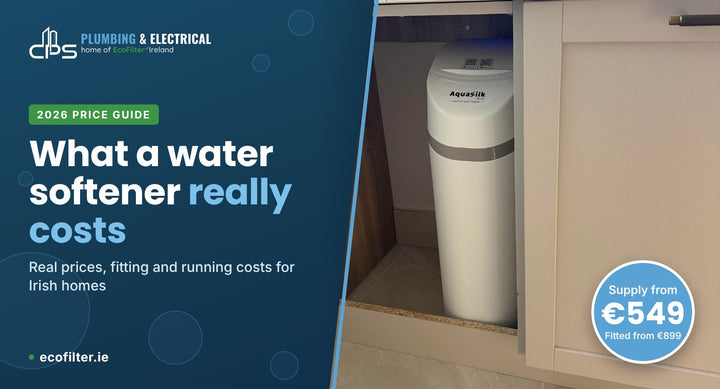
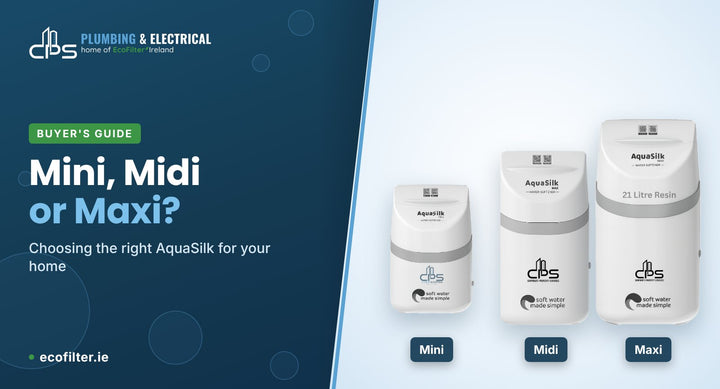
Because the hardness is physically removed, limescale can't form anywhere downstream: not in the cylinder, the immersion, the electric shower, the kettle, on the taps or on the shower screen. Soap and shampoo lather properly, and cleaning gets a lot easier. Our AquaSilk softener range starts at €549 supply only, or €899 fitted.
What a limescale filter or conditioner does
Salt-free products don't take the hardness out. Instead, they treat the water so the calcium is less likely to stick to surfaces as hard scale, particularly when it's heated. There are a few types:
- Conditioning media in a filter housing, like ScaleArmor Rock. It fits on the cold feed you want to protect, or on the whole house if sized correctly, and the media is changed every 6 to 12 months depending on usage and hardness. €399, or €549 fitted.
- Passive in-line conditioners, like the ScaleDP Limescale Guard. No power, no salt and nothing to change, with a typical life of 5 to 7 years.
- Small scale-reducing cartridges fitted ahead of a single appliance such as a boiling water tap or coffee machine.
All of them reduce scale build-up. None of them make water soft.
Side by side
| Water softener | Limescale filter or conditioner | |
|---|---|---|
| Removes hardness? | Yes | No, water still tests hard |
| Stops scale on taps and shower screens | Yes | Reduces it, doesn't stop it |
| Protects cylinder, immersion and electric shower | Yes, fully | Helps, especially on heated surfaces |
| Better lather, less soap and detergent | Yes | No |
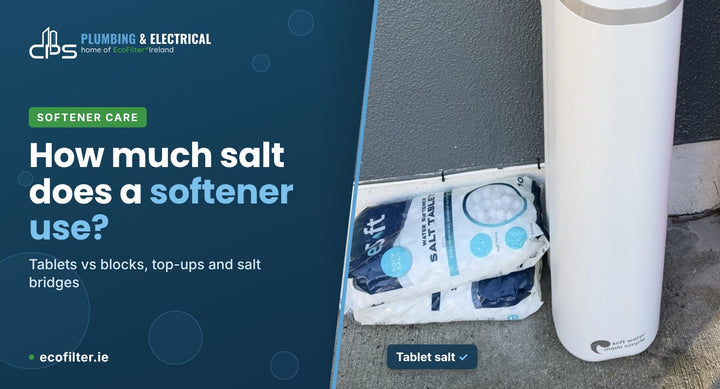
| Needs salt | Yes, tablet salt | No |
| Needs a drain and a socket | Yes | No |
| Space | A cabinet about the size of a kitchen bin | A filter housing or a short in-line unit |
| Ongoing costs | Salt, roughly €4 to €7 a month for a family of four | Media changes (ScaleArmor) or none (ScaleDP) |
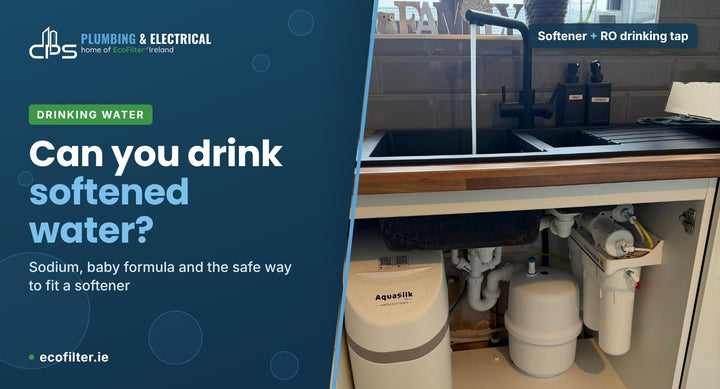
| Drinking water | Keep the kitchen cold tap unsoftened | No change needed |
| Price from | €549 supply only, €899 fitted | €399 supply only, €549 fitted (ScaleArmor Rock) |
Start with how hard your water is
Hardness is measured as mg/L of calcium carbonate. A typical Irish council scale runs like this: soft up to 50, moderately soft 51 to 100, slightly hard 101 to 150, moderately hard 151 to 250, hard 251 to 350, and excessively hard above 350. Look yours up with our Eircode hardness checker or our hardness levels by county.
- Under 100 mg/L: you probably don't need either.
- 100 to 200 mg/L: either can work. A conditioner may well be enough, especially in a smaller home.
- Over 200 mg/L: a softener is usually the better long-term answer. The harder the water, the more a conditioner struggles to keep up.
When a limescale filter or conditioner is the right call
- You're in an apartment or a rented home and can't fit a softener
- There's no drain or socket anywhere near the rising main
- Your water is only moderately hard
- You only want to protect one thing, like a combi boiler, a boiling water tap or a coffee machine
- You don't want to deal with salt at all
When a water softener is the right call
- Your water is hard or very hard, as it is in many parts of Leinster and the midlands
- You're replacing scaled immersion elements, shower parts or kettles more often than you should be
- You're fed up scrubbing taps, tiles and shower screens
- You want soft water: better lather and far less soap scum on the bath and shower
- You own the house and want a fix that covers every tap
If you go the softener route, see our water softener cost guide for prices and running costs.
Can you have both?
Yes, and sometimes it's the right answer. A common one is a softener for the house, with the kitchen cold tap kept on hard water for drinking and a scale-reducing cartridge in front of a boiling water tap on that hard line. If you're unsure which suits your house, send us your Eircode and a photo of where the water comes in and we'll tell you honestly.
Not sure which you need?
Send us your Eircode and a photo of where the mains comes into the house. We'll tell you whether a softener or a conditioner suits you, and give you a fitted price. We reply within one hour during office hours.
 5-star rated on Google
Frequently asked questions
Does a limescale filter soften water?
No. A limescale filter or conditioner changes how the hardness behaves so less scale sticks, but the calcium and magnesium stay in the water. Only a softener removes them.
Will a softener remove scale that's already in my pipes?
Softened water can gradually loosen old scale, which is why you may see some flakes after installation. It won't fully descale a cylinder or kettle that's already badly scaled, so those may still need cleaning or replacing.
Is water from a limescale conditioner safe to drink?
Yes. Conditioners don't add sodium, so the water is the same to drink as before. ScaleArmor Rock uses food-grade media.
Which is cheaper to run?
A conditioner, usually. ScaleDP has no running costs, and ScaleArmor needs its media changed every 6 to 12 months. A softener needs salt, roughly €4 to €7 a month for a family of four on hard water.