
- Readings from Uisce Éireann supply-zone data and regional estimates
 5.0 from 140 Google reviews
- Free to share with a link back
- Updated October 2026

Ireland's hard water map 2026
Where is the hardest water in Ireland?
Every town we have a public-supply reading for, ranked from hardest to softest, on one map. Tap a dot or a row to see the reading, where that town's water comes from, and whether a softener is worth it there. We've mapped 40 places so far and add towns as we get readings.
mg/L of calcium carbonate (CaCO₃), the standard measure. Dots marked "est." in the table are regional estimates rather than an Uisce Éireann supply-zone figure. Private wells are not on this map: they vary house to house and need a lab test.
Every town, ranked
0 places shown, hardest first
| # | Place | Hardness | mg/L | Band |
|---|
Not on the list? Type your Eircode and we'll show your own area's reading.
What the numbers mean for your house
Hardness is dissolved calcium and magnesium, picked up as water runs over limestone. The higher the number, the faster scale builds in the kettle, the immersion, the shower and the boiler.
Lake and upland water, mostly. Kettles stay clean, soap lathers easily. A softener is a waste of money here. South Dublin, Cavan town and Connemara are the obvious examples.
A light film in the kettle after a few months, some spotting on glass. Most people live with it. Galway city and the west Dublin blend sit here.
Scale on the shower screen within weeks, a crust on the immersion element inside two years, more detergent for the same wash. This is where a softener starts paying for itself.
Meath, Louth, Kildare, the midlands and north Fingal. Elements fail early, combi boilers lose efficiency, taps and shower heads clog. A softener is the normal fix, not a luxury.
Use this map
Journalists, bloggers, estate agents, county councils, teachers: the map and the table are free to use. All we ask is a credit and a link back to this page. Add the embed on the right and it stays up to date as we add towns, or download the map as an image.
Questions about the figures, or a reading for a town we haven't covered yet? Email info@ecofilter.ie. If you have a recent lab report for your supply we'll gladly add it.
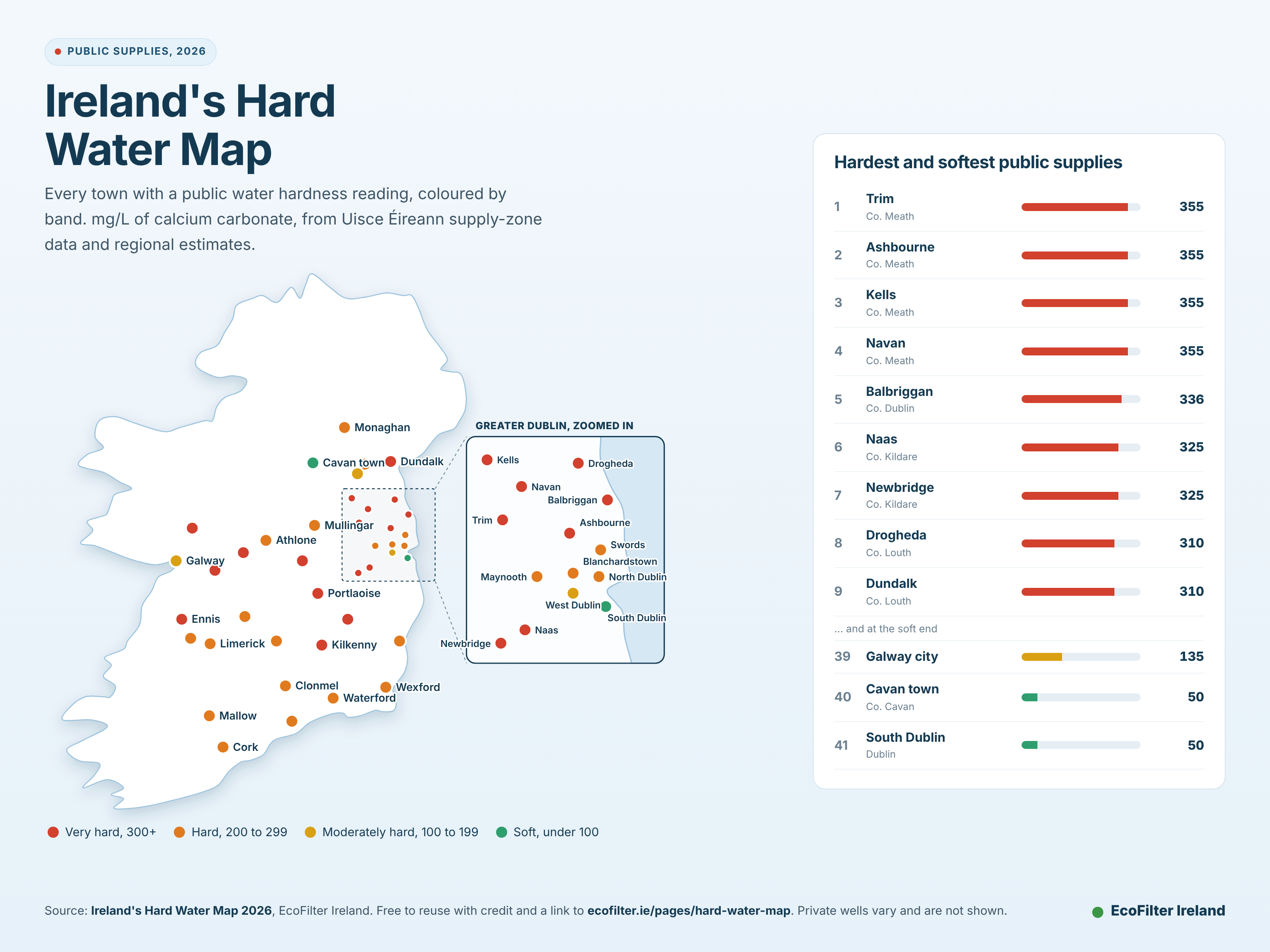
How the map is made
- Figures are total hardness as mg/L of calcium carbonate, the measure Uisce Éireann uses in its drinking water reports.
- Where Uisce Éireann publishes a supply-zone figure for a town, that's the number on the map.
- Where it doesn't, we use a regional estimate for the geology that supply sits on, and mark it "est." in the table. These are indicative, not a lab result for your tap.
- Bands follow the usual Irish convention: under 100 soft, 100 to 199 moderately hard, 200 to 299 hard, 300 and over very hard.
- Private wells and group water schemes are left out on purpose: two wells on the same road can differ by hundreds of mg/L.
Which town has the hardest water in Ireland?
Which town has the softest water?
Is Dublin water hard or soft?
How do I check my own house?
At what point is a softener worth it?
Can I use this map in an article or a report?
Softeners, town by town
Each page has the local reading, where that supply comes from, and what we fit there.
- Dublin200 mg/L
- BlanchardstownDublin 15, 200 mg/L
- SwordsCo. Dublin, 200 mg/L
- BalbrigganCo. Dublin, 336 mg/L
- NavanCo. Meath, 355 mg/L
- TrimCo. Meath, 355 mg/L
- KellsCo. Meath, 355 mg/L
- AshbourneCo. Meath, 355 mg/L
- DroghedaCo. Louth, 310 mg/L
- DundalkCo. Louth, 310 mg/L
- NaasCo. Kildare, 325 mg/L
- NewbridgeCo. Kildare, 325 mg/L
- MaynoothCo. Kildare, 200 mg/L
- MullingarCo. Westmeath, 280 mg/L
- AthloneCo. Westmeath, 280 mg/L
- TullamoreCo. Offaly, 300 mg/L
- PortlaoiseCo. Laois, 300 mg/L
- CarlowCo. Carlow, 300 mg/L
- KilkennyCo. Kilkenny, 300 mg/L
- GoreyCo. Wexford, 240 mg/L
- WexfordCo. Wexford, 240 mg/L
- WaterfordCo. Waterford, 230 mg/L
- DungarvanCo. Waterford, 230 mg/L
- ClonmelCo. Tipperary, 235 mg/L
- ThurlesCo. Tipperary, 235 mg/L
- NenaghCo. Tipperary, 235 mg/L
- Limerick city250 mg/L
- EnnisCo. Clare, 300 mg/L
- ShannonCo. Clare, 250 mg/L
- Galway city135 mg/L
- TuamCo. Galway, 300 mg/L
- LoughreaCo. Galway, 300 mg/L
- BallinasloeCo. Galway, 300 mg/L
- Cork city200 mg/L
- MallowCo. Cork, 200 mg/L
- MonaghanCo. Monaghan, 250 mg/L
- CarrickmacrossCo. Monaghan, 250 mg/L
- Co. Meath355 mg/L
- Co. Kildare325 mg/L
- Co. Louth310 mg/L
- Co. Westmeath280 mg/L
- Co. Offaly300 mg/L
- Co. Laois300 mg/L
- Co. Carlow300 mg/L
- Co. Kilkenny300 mg/L
- Co. Wexford240 mg/L
- Co. Waterford230 mg/L
- Co. Tipperary235 mg/L
- Co. Limerick250 mg/L
- Co. Clare300 mg/L
- Co. Galway300 mg/L
- Co. Cork200 mg/L
- Co. Monaghan250 mg/L
- Co. Cavan50 mg/L
- All of IrelandMain softener page
Red or orange dot over your house? Ask a plumber.
Send us your Eircode and a photo of where the mains comes in. We'll tell you the right size, the fitted price, and whether a softener is even the right answer for your water.
Helpful guides
Before you buy a water softener
 Pay monthly for a water softenerYou can now spread the cost of any softener, drinking water system or boiling tap with humm. Here's what the...Read the guide
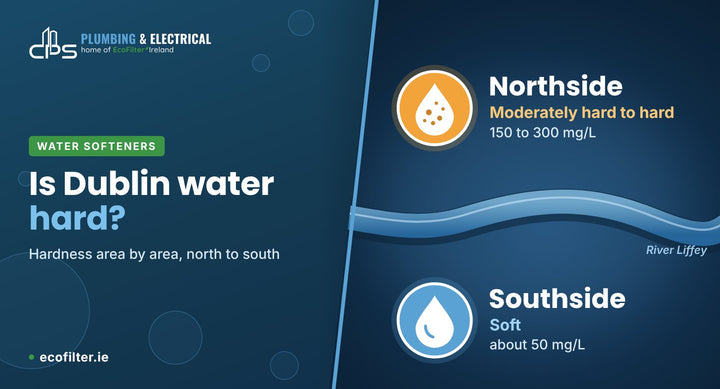 Is Dublin water hard?How hard your water is in Dublin depends on which treatment plant supplies your area. Most of the northside is...Read the guide
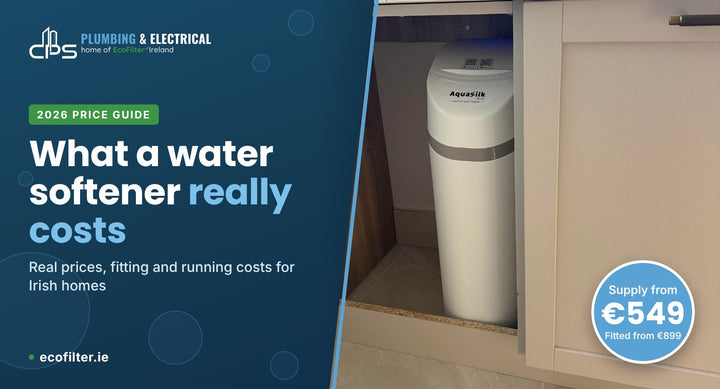 What a water softener costs in IrelandOur real 2026 water softener prices, from €549 supply only to €1,150 fitted, plus what's included in an installation, what...Read the guide
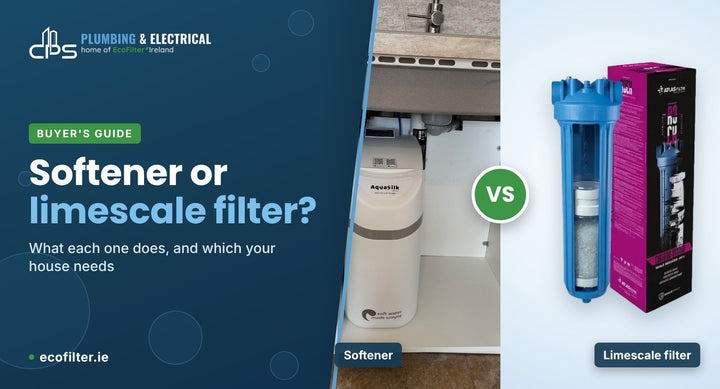 Water softener or limescale filter?Salt-based softeners and salt-free limescale filters do different jobs. What each one actually does, how they compare on cost and...Read the guide
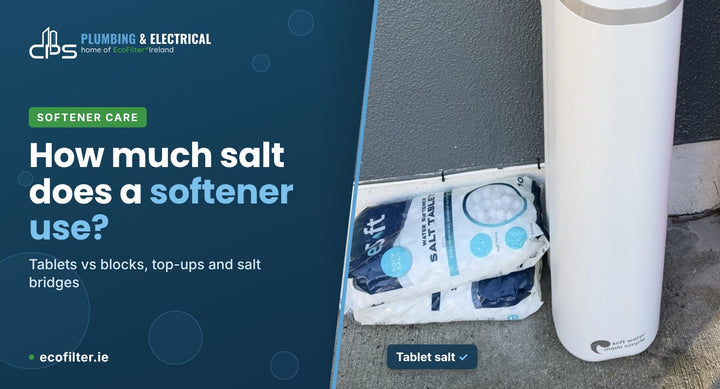 Softener salt: which type and how muchWhich salt to buy for your water softener, how much a typical Irish household gets through each month, how often...Read the guide
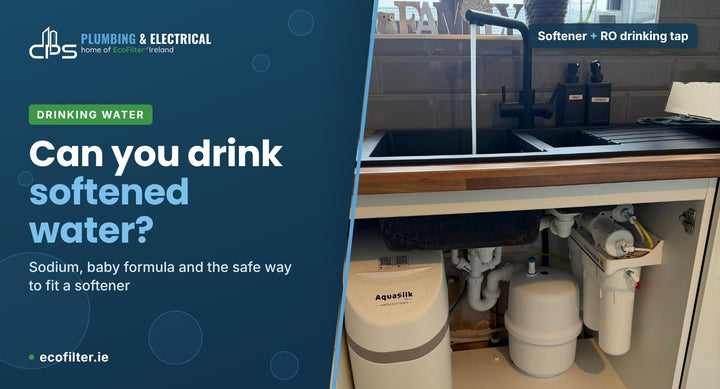 Can you drink softened water?Softened water is safe for most adults to drink, but there are exceptions. How much sodium a softener really adds,...Read the guide