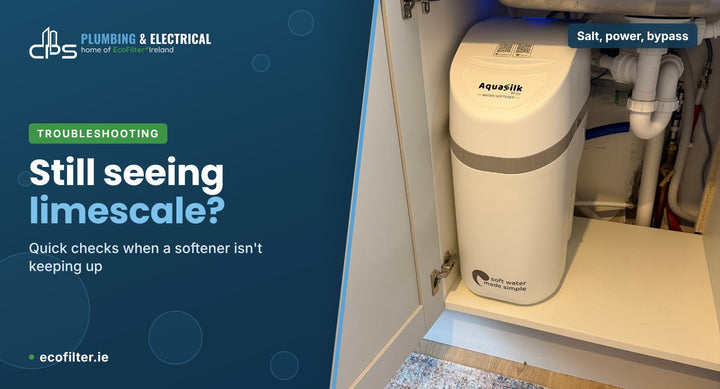
Salt is the only thing a water softener really asks of you. Get it right and the softener looks after itself. Get it wrong, with the wrong type of salt, a crust in the tank or an empty tank, and the hard water creeps back without you noticing. Here's which salt to buy, how much you'll get through, and how to keep the tank in good shape.
Quick answer
- Which salt: high-purity tablet salt for cabinet softeners like the AquaSilk and Clack
- How much: a family of four on hard water uses roughly 6 to 11 kg a month, so a 25 kg bag lasts about 2 to 4 months
- How often to check: once a month. Keep the salt above the water level and top up when it's down to about a third
- Biggest problem to watch for: a salt bridge, a hard crust that stops the softener making brine
Which salt to use: tablets, blocks or granular?
| Type | What it is | Use it in a cabinet softener? |
|---|---|---|
| Tablet salt | Compressed tablets of high-purity salt | Yes. This is what the AquaSilk and Clack cabinet softeners are designed for |
| Block salt | Large pre-formed blocks | Only in softeners built for blocks. Not for AquaSilk or Clack cabinets |
| Granular salt | Loose crystals, like dishwasher salt | Not unless your manufacturer says so. It dissolves quickly and is more likely to turn to sludge |
| Loose rock, table or gritting salt | Unrefined lumps, or salt with additives | No. Unrefined rock salt and gritting salt carry dirt that clogs the valve, and table salt contains anti-caking additives |
Buy tablets labelled for water softeners, in 10 kg or 25 kg bags. Some tablet bags say ‘rock salt’ on them: that just means the tablets are made from purified rock salt, and they're fine. What you want to avoid is loose, unrefined rock salt. Cheap, low-purity tablets leave more residue in the tank and are more likely to bridge.
How much salt will I use?
There's no single answer, because salt use depends on three things: how hard your water is, how much water the house uses, and how efficiently the softener regenerates. A modern metered softener only regenerates when the resin is actually used up, so it uses far less salt than an older timer-only model.
As a rough guide, here's what a modern metered softener uses in a month:
| Household | Water at 200 mg/L | Water at 300 mg/L | Water at 350 mg/L |
|---|---|---|---|
| 1 to 2 people | 1.5 to 3 kg | 2.5 to 4.5 kg | 2.5 to 5.5 kg |
| 3 to 4 people | 4.5 to 6 kg | 7 to 9.5 kg | 8 to 11 kg |
| 5 to 6 people | 8 to 9.5 kg | 11.5 to 14 kg | 13.5 to 16.5 kg |
Our estimate, assuming about 130 litres per person per day (the CSO's figure for the average metered Irish home is 357 litres a day) and a typical efficient metered softener. Older timer-based softeners can use up to twice as much. Not sure how hard your water is? Use our Eircode hardness checker.
Using a lot more than this? Check for a leaking toilet first. A cistern that's constantly trickling into the pan runs softened water all day and night. Put a few drops of food colouring in the cistern and wait 25 minutes. If the colour shows up in the bowl, you've found it. Also check the hardness setting hasn't been set far higher than your water needs.
How often should I top up the salt?
Check the salt level once a month, and top up when it's down to about a third. Keep the salt above the level of the water in the tank, but don't fill it to the brim every time, because a tank that's always packed full is more likely to form a crust.
How often you'll actually be filling it depends on the size of the salt tank:
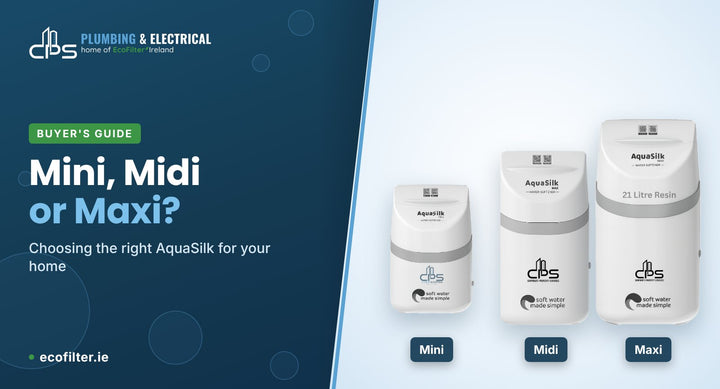
- AquaSilk Mini: holds 15 kg. A family of four on 300 mg/L water will be topping up roughly every 6 to 7 weeks.
- AquaSilk Midi: holds 29 kg, so roughly every 3 months for the same household.
- AquaSilk Maxi: holds 46 kg, so several months between top-ups.
Salt bridges: the most common softener problem
A salt bridge is a hard crust that forms across the salt tank, usually just above the water. The tank looks full from the top, but underneath the crust there's a hollow with no salt touching the water. The softener can't make brine, so it regenerates with plain water, and within a few days the water goes hard again.
Signs of a salt bridge:
- The salt level hasn't dropped in weeks, even though the softener is working
- Limescale spots are back on the shower screen or taps
- Soap and shampoo don't lather like they did
How to fix it: lift the lid and gently push a broom handle down through the salt in a few places to break the crust. Don't bash it with anything hard, as you can crack the tank. Top up with fresh tablets, give it a couple of hours to make brine, then run a manual regeneration so the resin is recharged. If the water still feels hard after that, work through our softener troubleshooting checklist.
Salt mushing is the other one: a layer of sludge at the bottom of the tank where salt has dissolved and re-formed as paste. It's usually caused by low-quality or granular salt. Scoop it out and clean the tank.
To prevent both, use good-quality tablets, don't overfill, and keep the softener out of damp or very humid spots.
Cleaning the salt tank
Every year or two, let the salt run low, then scoop out any sludge or residue, rinse the tank and refill with fresh tablets. Keep the lid on at all times so nothing falls in.
What happens if I run out of salt?
Nothing dramatic. Without salt the softener can't recharge the resin, so the house slowly goes back to hard water. Top up the tablets, wait a couple of hours for brine to form, then run a manual regeneration. You'll be back to soft water straight away on the cold side. The hot water can take a while longer to clear while the cylinder refills.
Where to buy salt, and what it costs
Builders' merchants, plumbers' providers, DIY stores and some supermarkets all stock softener tablets. Expect to pay around €15 for a 25 kg bag, though prices vary. Store bags somewhere dry and off the floor, and keep an unopened bag in reserve so you're never caught short.
For a family of four on hard water, that works out at roughly €4 to €7 a month. See what else a softener costs to own in our water softener cost guide.
Softener not behaving?
We service and repair water softeners, including other brands, and we supply and fit the AquaSilk range nationwide except Donegal, Kerry, Leitrim and Sligo. Send us a photo of the unit and its screen and we'll usually know what's wrong.
 5-star rated on Google
Frequently asked questions
Does softener salt get into my drinking water?
No. The salt is only used to make brine that recharges the resin, and that brine is rinsed to drain. What changes is that a small amount of sodium is swapped in for the hardness removed.
Can I use dishwasher salt in my water softener?
It's not recommended for cabinet softeners like the AquaSilk or Clack. Dishwasher salt is granular, dissolves quickly and is more likely to turn to sludge in the tank. Use tablet salt made for water softeners.
Can I use potassium chloride instead of salt?
Some softeners can run on potassium chloride, but it costs more and regenerates less efficiently, so you'll use more of it. Check with us or your softener's manual before switching.
Why is my softener not using any salt?
The most common reason is a salt bridge, a crust that stops the salt reaching the water. Also check the softener has power, the bypass is in the service position and it's actually regenerating.
How do I know if my softener needs salt?
Lift the lid. If you can see water above the salt, or the salt is down to about a third, top it up. Hard water signs coming back, like spots on glass or poor lather, are another clue.