Ask around Dublin whether the water is hard and you'll get two different answers, and both are right. Dublin's water comes from several treatment plants, and how hard it is depends on which one feeds your street. Much of the northside gets moderately hard to hard water. Most of the southside gets soft water. Here's where each supply goes, how hard it is, and whether a water softener is worth it where you live.
Quick answer
- Northside and north county (Leixlip supply): moderately hard to hard, roughly 150 to 300 mg/L. A softener is usually worth it
- Southside and Dún Laoghaire-Rathdown (Ballymore Eustace, Ballyboden and Vartry supplies): soft, around 50 mg/L. You don't need a softener
- The west side (Dublin 10, 12, 20, 22 and Lucan): can get either supply or a blend, so it varies
- North Fingal (Balbriggan, Skerries and nearby): some homes get naturally hard groundwater, harder again than the Leixlip supply
Where Dublin's water comes from
Most of Dublin's water starts in Wicklow and Kildare and is treated at a handful of plants. The difference in hardness comes down to what the water flows over before it's collected.
- Ballymore Eustace takes water from the Poulaphouca reservoir (the Blessington Lakes), fed from the Wicklow Mountains. The water runs off granite and bog, picks up very little calcium, and arrives soft.
- Ballyboden treats water from the Bohernabreena reservoirs in the Dublin Mountains. Also soft.
- Vartry treats water from the Roundwood reservoir in Co. Wicklow. Also soft.
- Leixlip takes water from the River Liffey much further downstream, after it has crossed the limestone of Co. Kildare and picked up calcium and magnesium on the way. It supplies more than 600,000 people across the Greater Dublin Area, and it's the main source of hard water in the county.
- The Bog of the Ring is a groundwater supply in north County Dublin. It's drawn from boreholes in limestone and is naturally harder than the Leixlip water.
Uisce Éireann balances the supply between Leixlip and Ballymore Eustace every day to meet demand, so homes near the boundary can get one, the other or a blend. Since 2018, Leixlip water has been extended to Lucan, Palmerstown and north Clondalkin.
Dublin water hardness by area
| Area | Usual supply | How hard | Softener? |
|---|---|---|---|
| Dublin 3, 5, 7, 9, 11, 13, 15 and 17 | Leixlip | Moderately hard to hard, about 150 to 300 mg/L | Usually worth it |
| Swords, Malahide, Portmarnock, Howth | Leixlip | Moderately hard to hard | Usually worth it |
| Dublin 10, 12, 20 and 22, Lucan, Palmerstown, Clondalkin | Leixlip, Ballymore Eustace or a blend | Varies, from soft to hard | Check your water first |
| Dublin 2, 4, 6, 6W, 8, 14, 16, 18 and 24 | Ballymore Eustace or Ballyboden | Soft, about 50 mg/L | No |
| Blackrock, Dún Laoghaire, Dalkey, Bray | Ballymore Eustace or Vartry | Soft | No |
| Balbriggan, Skerries, Rush, Lusk | Bog of the Ring groundwater, Leixlip | Very hard, about 336 mg/L | Usually worth it |
Treated water leaving Leixlip has been reported at 150 to 300 mg/L, and water leaving Ballymore Eustace, Ballyboden and Roundwood at about 50 mg/L, in water services replies to South Dublin County Council. Hardness isn't one of the regulated drinking water parameters, so it isn't published street by street. Supply areas don't follow postcodes exactly, so treat this table as a guide.
Check your own address: put your Eircode into our water hardness checker. Or look in the kettle: if there's a white crust on the element within a few weeks of descaling, your water is hard enough for a softener to make a real difference.
What the numbers mean
Hardness is measured in milligrams per litre (mg/L) of calcium carbonate. There's no single official scale, and councils band it in different ways. This is the scale we use across our site and in our hardness checker:
| mg/L | Classification | What you'll notice |
|---|---|---|
| Under 100 | Soft | Little or no scale. Soap lathers easily |
| 100 to 199 | Moderately hard | Some scale in kettles over time, spots on glass |
| 200 to 299 | Hard | Kettles fur up quickly, scale on taps and shower screens |
| 300 and over | Very hard | Heavy scale, shorter life for heating elements and appliances |
For hardness levels outside Dublin, see water hardness by county.
Is hard water bad for you?
No. Hard water is safe to drink, and there's no limit for hardness in the Irish drinking water regulations. Calcium and magnesium aren't harmful, and plenty of people prefer the taste. Uisce Éireann doesn't soften the public supply. The problem with hard water is limescale, not health.
What hard water does in a Dublin house
- Electric showers: scale builds on the element and blocks the spray plate, cutting the flow and shortening the shower's life.
- Immersions and cylinders: scale coats the element and the coil, so heating the water takes longer and costs more.
- Combi boilers: the small plate heat exchanger that heats your hot water is one of the first parts to scale up.
- Kettles, dishwashers and washing machines: furred elements, cloudy glasses and more detergent to get a lather.
- Taps, tiles and screens: the white crust that takes the most cleaning.
Do you need a water softener in Dublin?
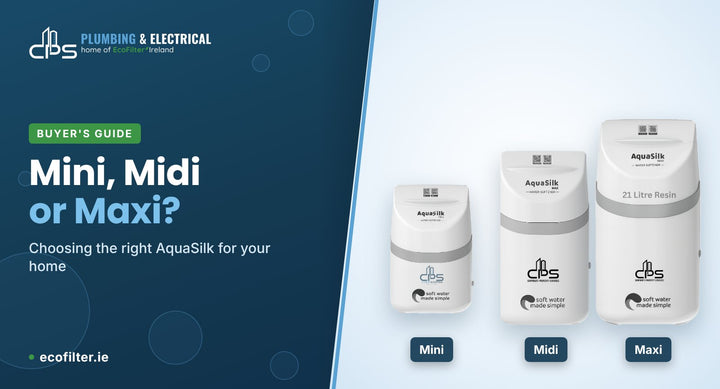
On the northside and in north County Dublin, usually yes. A softener is the only thing that stops limescale at every tap, in the shower and inside the cylinder. For most family homes on Leixlip water we fit the AquaSilk Midi. Apartments and smaller houses usually suit the Mini. Prices start at €899 fitted. See our water softener cost guide and our pages for Dublin, Swords, Blanchardstown and Balbriggan.
On the southside, no. Your water is already soft, so a softener would cost money and do nothing. If the issue is taste or a chlorine smell, a drinking water filter is the right fix. Here's why tap water tastes of chlorine.
On the west side, it depends. If your kettle and shower are scaling up, you're getting Leixlip water and a softener will help. If scale is light, a limescale filter on the boiler feed may be all you need. We explain the difference in Water Softener vs Limescale Filter.
On a private well? These figures are for the public supply only. Well water in rural County Dublin can be much harder and often carries iron or manganese, which will foul a softener. We arrange analysis through an independent accredited lab first, then specify the treatment. See well water treatment.
Find out if your Dublin home needs a softener
Tell us your Eircode and how many live in the house. We'll tell you honestly whether a softener is worth it, and if it is, which size and what it costs fitted. No obligation.
 5-star rated on Google
Frequently asked questions
Is Dublin water hard or soft?
Both. Homes supplied from Leixlip, mostly on the northside and in north County Dublin, get moderately hard to hard water. Homes supplied from Ballymore Eustace, Ballyboden or Vartry, mostly on the southside, get soft water.
Why is northside water harder than southside water?
The Leixlip plant draws from the Liffey after it has flowed across limestone in Kildare, which adds calcium and magnesium. The southside plants draw from reservoirs in the Wicklow and Dublin Mountains, where the water runs off granite and bog and stays soft.
Does Uisce Éireann soften the water?
No. Hardness is a natural feature of the water and isn't treated out at the plant. If you want soft water, it has to be done in the house with a water softener.
Can I drink softened water?
We recommend keeping the kitchen cold tap on unsoftened water for drinking and cooking, and we set that up on every softener we fit. Here's why that matters.
Will a softener work on Dublin water?
Yes. A softener removes the calcium and magnesium whatever the source. We set it to the hardness of your supply when we commission it, so it isn't using more salt than it needs. Our salt guide covers what it costs to run.