If you're on a private well and the kettle is furring up, a water softener is the obvious fix. Sometimes it's the right one. But well water rarely has just one problem, and a softener fitted in the wrong place, or before anything else is sorted, can clog up within months or leave a bigger problem untreated. Here's how to work out what your well needs first, and where a softener fits in.
Quick answer
- Test before you buy anything. An independent accredited lab report tells you whether you're dealing with hardness alone, or iron, manganese, acidity or bacteria as well
- Safety comes first: bacteria are the most important thing to deal with, but the UV that kills them goes at the end of the line, not the start
- Typical order: sediment filter, then iron, manganese or smell removal (with pH correction if needed), then the softener, then a fine filter and UV, with reverse osmosis at the kitchen tap if you want it
- Grant: the private well grant does not cover water softeners
Why the order matters on a well
On a mains supply, a softener is usually the only thing between the stopcock and your taps. On a well, each piece of equipment protects the one after it, so the order is what makes the whole system last.
- Iron and manganese foul softener resin. A softener can take out a small amount of dissolved iron, but at higher levels the resin gets coated and stops softening. That's why an iron filter goes in ahead of it.
- Iron and hardness coat UV lamps. The EPA's water treatment manual on disinfection notes that iron and hardness can build up mineral deposits on the quartz sleeve around a UV lamp, blocking the light. A coated sleeve means bacteria can get through, so the softener and filters go before the UV.
- Grit and sediment block everything. A sediment filter at the start stops sand and silt reaching valves and filter media.
What to treat first, problem by problem
| What the lab report shows | What you'll notice | What goes in | Where in the line |
|---|---|---|---|
| Sediment or cloudy water | Grit in taps, cloudy glasses | Sediment filter | First |
| Low pH (acidic water) | Blue-green stains, pinholes in copper pipes | pH correction filter | Early, before iron removal |
| Iron above 200 µg/l | Orange staining, metallic taste | Iron filter that backwashes itself | Before the softener |
| Manganese above 50 µg/l | Black or dark brown staining | Manganese filter, sometimes with dosing ahead of it | Before the softener |
| Rotten egg smell | Smell from the hot or cold taps | Catalytic carbon filter | Before the softener |
| Hard water | Limescale in kettles, showers and on glass | Water softener | After the filters, before UV |
| E. coli or coliforms | Usually nothing you can see | Fine filter and UV, often after the well is shock chlorinated | Last on the whole house supply |
The iron and manganese figures are the parametric values in the European Union (Drinking Water) Regulations 2023, S.I. 99 of 2023. Not every well has every problem. Most need two or three of these stages, not all seven.
For more on orange staining and how it's removed, see our guide to iron in well water.
Step one: get the right test
We don't test water ourselves. An independent, accredited lab analyses a sample from your well and we specify the treatment from its report. You can order the test through us: Fitz Scientific, an INAB-accredited lab in Drogheda, analyses it, and if we fit the treatment within 90 days the test fee comes off the job. For a softener decision, make sure the test covers hardness, iron, manganese and pH, as well as E. coli and coliform bacteria. If you're near farmland, ask for nitrate too.
The EPA recommends testing a private well at least once a year for bacteria, and every three years for chemical contamination. It also says to test after heavy rain, or if the water changes in smell, taste or colour.
Soft well? Don't buy a softener. Plenty of Irish wells aren't hard at all. If the report shows low hardness and you still see staining, the problem is iron, manganese or acidity, and a softener won't fix it.
Bacteria: treat it first, fit it last
It sounds backwards, but it isn't. If the report shows E. coli or coliforms, that's the problem to deal with before anything cosmetic, and you shouldn't drink the water untreated in the meantime. Ask your council or the HSE for advice on what to do while you wait.
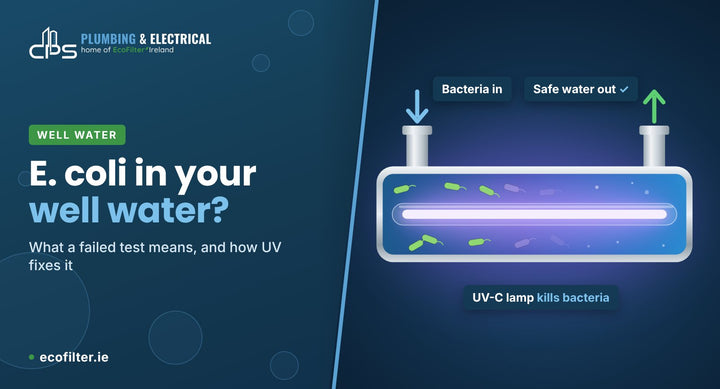
The fix usually means shock chlorinating the well with bleach to clear it, finding and fixing how the contamination got in where possible, and fitting UV to treat every drop that comes into the house. The UV unit physically sits at the end of the line, after the softener and a fine filter, so it gets clean, clear water and works properly.
A softener does not make water safe. It removes calcium and magnesium. It does nothing to bacteria, nitrate or most other contaminants. If your well has failed a bacteria test, a softener on its own leaves the real problem in place.
Choosing the softener itself
Once the water reaching the softener is clear and low in iron and manganese, a softener does the same job on a well as on the mains, but it isn't an off-the-shelf box. Our AquaSilk range is for mains water only. On a well we build a Clack softener to suit your report, sized to the household and the hardness on it, and fitted as part of the whole line. Because it's specified from the report, it isn't sold online: we quote it, and you pay on the day it's fitted or by a secure payment link beforehand.
Two well-specific things to check:
- Pump and pressure. Softeners and self-cleaning filters need a good flow of water to regenerate and backwash. A weak or old pump may need attention first.
- Space. On a well, several units usually go in a row where the supply enters the house, in a garage, shed or utility room. Each needs access for salt, servicing and a drain.
The grant and the softener
The private well grant can help with treatment, but the council terms are clear that a water softener is not covered. Work must not start before the council approves it in writing, and for the grant the lab has to take the water sample, not you. If you're applying, get the softener quoted as a separate item so it's easy to leave out of the claim. Our private well grant guide covers who qualifies and how to apply, and our well water treatment cost guide shows what full setups cost.
Not sure what your well needs first?
Send us your lab report and we'll tell you what to treat, in what order, with an itemised quote, VAT included. Our own plumbers fit and service it, nationwide except Donegal, Kerry, Leitrim and Sligo.
 5-star rated on Google
Common questions
Can I put a softener straight onto my well?
Only if the lab report shows the water is hard but otherwise clear, with low iron and manganese and no bacteria. Otherwise something else needs to go in first.
Will a softener remove iron from well water?
A small amount, but not reliably. Higher levels coat the resin and the softener stops working, so fit an iron filter ahead of it.
Should the UV go before or after the softener?
After. Hard water and iron leave deposits on the UV lamp sleeve, which blocks the light. Softened, filtered water keeps the sleeve clean.
Can I drink softened well water?
Only once the well has passed a bacteria test or is protected by UV. Many households also fit reverse osmosis at the kitchen tap for drinking and cooking water.
Does the well grant pay for a softener?
No. The grant can cover other treatment, but softeners are excluded. Have it priced separately on your quote.
Can you work out what I need from the lab report alone?
Usually, yes. Send the report and a few photos of where the supply comes in through our well water treatment page and we'll come back with a plan.