Nitrate is one of the well water problems that gives you no warning. You can't rely on taste, smell or colour to spot it, so a well can look perfect and still be over the limit. It matters most where a baby is on bottle feeds, and it's more likely on a shallow well in farming country.
Quick answer
- The limit: 50 mg/L for nitrate and 0.50 mg/L for nitrite, under the Irish drinking water regulations (S.I. 99 of 2023)
- Who it matters most for: bottle-fed babies, especially in their first few months
- Boiling: doesn't remove nitrate, and can concentrate it
- The fix: reverse osmosis at the kitchen tap for drinking and cooking water, or ion exchange for the whole house where that's justified. Get a lab test first, and test again after
What is the safe limit for nitrate in well water?
The European Union (Drinking Water) Regulations 2023, S.I. 99 of 2023, set the limits below. A household well is exempt from those regulations, but the EPA, the HSE and your council judge well water against these standards, and so does the well grant.
| Parameter | Irish limit | WHO guideline | EPA and HSE advice |
|---|---|---|---|
| Nitrate | 50 mg/L | 50 mg/L | Don't drink water above 50 mg/L on a regular basis |
| Nitrite | 0.50 mg/L | 3 mg/L | Above 0.5 mg/L, don't drink it regularly and find out why. Above 3 mg/L, stop using the supply straight away |
There's also a combined rule for the two, so a report showing nitrate and nitrite both close to their limits needs a closer look.
Check the units on your lab report. The 50 mg/L limit is for nitrate measured as nitrate (NO3). Some reports give it as nitrogen (N). Using the EPA's factor of 0.2259, 50 mg/L of nitrate is about 11.3 mg/L as nitrogen.
Why nitrate matters most for babies
The EPA and HSE say the 50 mg/L standard is there to protect bottle-fed babies from methaemoglobinaemia, better known as blue baby syndrome. Bacteria in a young baby's gut turn nitrate into nitrite, and nitrite stops the blood carrying oxygen around the body properly.
Breastfeeding protects babies from it, and from about four months of age they gradually become less vulnerable. A tummy bug at the same time may raise the risk. The condition is rare in Western Europe, and a standard that protects babies protects everyone else in the house too.
For adults, the EPA and HSE describe the evidence on thyroid effects as limited and conflicting. The International Agency for Research on Cancer lists nitrate and nitrite as probably carcinogenic under certain conditions in the body, but the EPA and HSE say the weight of evidence does not clearly support a link between nitrate or nitrite themselves and cancer. Their advice for everyone: don't drink water over the limit on a regular basis.
Making up bottle feeds on a well that's over the limit? The EPA and HSE advise using another safe supply or bottled water, but not bottled water labelled natural mineral water, which can be high in sodium. Boil the water once and let it cool, or use ready-to-use formula. Don't switch to softened water either: the HSE says water from a softener may contain too much sodium for formula, and a softener doesn't remove nitrate anyway.
Where does nitrate in well water come from?
Nitrate dissolves easily, so what goes on the land can soak down into the groundwater your well draws from. The EPA and HSE name the main sources:
- Farming. Agriculture is the main source of nitrogen in Irish groundwater, with grassland the biggest contributor overall and tillage important in the drier East and South-East. It gets in through leaks from storage areas and through spreading of fertilisers and manures.
- Septic tanks. A poorly working septic tank nearby can add nitrate too, and shallow wells in farming areas are the most at risk.
The EPA's distances are a useful check: no spreading of slurry within 25 metres of the well, the farmyard at least 15 metres away, and slurry stores, slatted sheds and silage clamps at least 50 metres away. Test for bacteria at the same time.
Where in Ireland is groundwater nitrate highest?
The EPA's Water Quality in 2025 report, published in June 2026, looked at 179 groundwater monitoring sites over 2023 to 2025:
- 23% of sites had nitrate above 25 mg/L, the level the EPA treats as elevated.
- High readings persist mainly in the South East and in the Midlands and East.
- Two sites were over the 50 mg/L drinking water limit: Sheepgrange in Co. Louth and Dunkerrin Guilfoyles Well in Co. Offaly.
- In 2025, nitrate rose in the South East, Western and South West regions. The Western and Border regions are still low, though the Western region has been creeping up since 2021.
These are monitoring sites, not household wells, so only a test of your own well tells you where you stand.
How do I know if my well has nitrate?
Only a lab test will tell you. The EPA advises testing a well at least once a year for bacteria and every three years for chemicals, with a nitrate test for wells in farming areas. The best time to sample is after heavy rain. If a result comes back over the limit, the EPA and HSE advise repeating the test as soon as possible.
We don't test water ourselves. An independent, accredited laboratory takes and analyses the sample, and we specify treatment from that lab report. For the well grant, the laboratory has to take the sample, not you.
Boiling doesn't remove nitrate
The EPA and HSE say boiling, filtering, disinfecting and softening do not remove nitrate. Boiling can actually raise the level, because water boils off and the nitrate stays behind, so only bring water to a rolling boil.
| Treatment | Removes nitrate? |
|---|---|
| Boiling | No, and it can concentrate it |
| Jug filter or carbon cartridge | No |
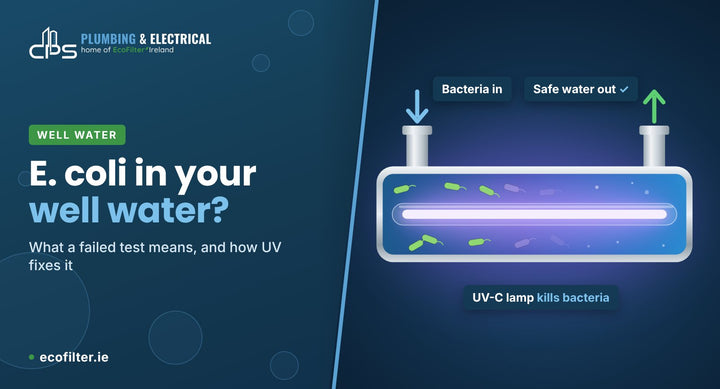
| UV system | No. It kills bacteria but doesn't touch nitrate |
| Water softener | No |
| Reverse osmosis | Yes |
| Ion exchange for nitrate | Yes |
How to remove nitrate from well water
The EPA and HSE list reverse osmosis and ion exchange among the treatments capable of removing over 80% of nitrate.
Reverse osmosis at the kitchen tap
Reverse osmosis forces water through a very fine membrane under pressure, leaving the nitrate behind. Because the concern is the water you drink, cook with and use for bottle feeds, treating the kitchen tap is usually the sensible and economical answer.
Our EcoSoft Standard Pro is an under-sink reverse osmosis system with a mineraliser that puts calcium and magnesium back. The drinking water regulations note that adding calcium and magnesium back to membrane-treated water can make it less corrosive and improve the taste. It's €289.99 supply only or €449 fitted, and the annual filter change is €89 as a DIY kit or €150 fitted by us. See our reverse osmosis cost guide for the full picture.
Ion exchange for the whole house
Ion exchange swaps nitrate for chloride as the water passes through a bed of resin. It treats every tap, so it makes sense where nitrate is well over the limit and all the water in the house needs to be fit to drink. An ordinary water softener does not do this job. The EPA and HSE say the waste water from backwashing must be disposed of properly.
The EPA and HSE also mention blending with another supply or using an alternative supply, and advise contacting your local authority if results stay over the limits.
Test again after it's fitted. The EPA and HSE say ongoing monitoring is needed. Run the system for at least two weeks, then have the treated water tested. For the grant, a passing post-works test is required anyway.
Can the well grant help?
The Domestic Private Well Grant pays 100% of approved water treatment costs, up to €1,000, with nothing paid where the total cost is under €750. The house must be more than seven years old, and work must not start until the council has approved it in writing. Whether a nitrate system qualifies is the council's decision. Our private well grant guide goes through the steps.
More on well water: well water treatment, bacteria in well water and black staining and manganese.
Common questions
Does boiling well water remove nitrate?
No. Boiling leaves nitrate behind, and long boiling can increase the level as water evaporates.
Will a water softener or UV system remove nitrate?
No. A softener removes hardness and UV kills bacteria. You need reverse osmosis or ion exchange.
Can I make up baby formula with my well water?
Only if a recent lab test shows it's within the limits for nitrate and nitrite and free of E. coli. If not, use another safe supply or ready-to-use formula.
How often should I test my well for nitrate?
The EPA advises a chemical test every three years, with nitrate included for wells in farming areas. Test sooner if a result was over the limit or a baby is on the way.
Nitrate on your lab report?
Send us your lab report and we'll tell you what your water needs and what it doesn't. Our own plumbers fit and service well water treatment nationwide except Donegal, Kerry, Leitrim and Sligo.
 5-star rated on Google